Wednesday, April 15, 2020
find vs logical indexing
people usually use "find" to get some values with a threshold, but the logically indexing is much easier and faster. This is the lesson I learned today:
https://www.mathworks.com/help/matlab/matlab_prog/find-array-elements-that-meet-a-condition.html
https://www.mathworks.com/matlabcentral/answers/66992-logical-indexing-is-usually-faster-than-find
n = 1e6;
r = rand(n,1);
f = randn(n,1)+10;
si = r>0.5;
tic
j = find(si);
s1 = f(j); % with FIND
toc
tic
s2 = f(si); % with logical indexing
toc
all(s1==s2)
This is the best example I found, I usually used s1 method, but s2 is faster, if you dont' need the actual index number

Sunday, April 12, 2020
load and wirte tif stacks in matlab
It takes time to search for these codes, for convenience, let me keep a copy her for everyone.
This will read from a tif stack (not many single files):
Read part:
fname = '20191229_fov02_14.tif';
info = imfinfo(fname);
num_images = numel(info);
B = imread(fname,1);
for k = 2:num_images
A = imread(fname, k);
B = cat(3,B,A);
end
Save part:
outputFileName = 'filteredbinary.tif';
imwrite(afterOp(:, :, 1), outputFileName, 'Compression','none');
for K=2:length(afterOp(1, 1, :))
imwrite(afterOp(:, :, K), outputFileName, 'WriteMode', 'append', 'Compression','none');
end
dilution, errosion, openning and closing
These are important basic concepts in image processing. see nice videoes here:
https://www.youtube.com/watch?v=ZTbGlriKFtU
https://www.youtube.com/watch?v=IcBzsP-fvPo
learning matlab image processing-1: imbinarize
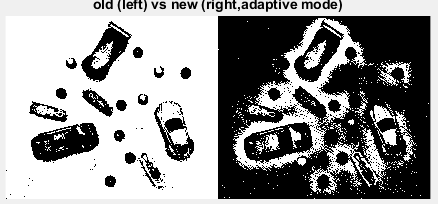
Today I found a great function of matlab for image processing: imbinarize
This function actually replaces the im2bw function. To get an idea of the difference, here is an example.
If we just the old code and the new function in 'global'(default) model. There is not much difference:
level = 0.57;
Ithresh = im2bw(Igray,level);
BW=imbinarize(Igray);
imshowpair(Ithresh, BW, 'montage');
title('old (left) vs new (right,global mode)')
 However, the really useful part is the 'adaptive' function for this binarizer:
level = 0.57;
Ithresh = im2bw(Igray,level);
BW=imbinarize(Igray,'adaptive');
imshowpair(Ithresh, BW, 'montage');
title('old (left) vs new (right,global mode)')
However, the really useful part is the 'adaptive' function for this binarizer:
level = 0.57;
Ithresh = im2bw(Igray,level);
BW=imbinarize(Igray,'adaptive');
imshowpair(Ithresh, BW, 'montage');
title('old (left) vs new (right,global mode)')
 This actually saves the effort to split the channels of RGB and segment them separately, as described here in the old version of matlab (https://www.youtube.com/watch?v=1-jURfDzP1s, a very nice presentation).
Find out more details about this function in https://www.mathworks.com/help/images/ref/imbinarize.html
Good thing is that it also works for 3D stacks. will give it try:)
This actually saves the effort to split the channels of RGB and segment them separately, as described here in the old version of matlab (https://www.youtube.com/watch?v=1-jURfDzP1s, a very nice presentation).
Find out more details about this function in https://www.mathworks.com/help/images/ref/imbinarize.html
Good thing is that it also works for 3D stacks. will give it try:)

Tuesday, April 7, 2009
RNA Extraction with TRIZOL
Wear gloves when handling trizol, work RNase-free!
1. Aspirate medium from cells grown in dishes
2. Wash with 1XPBS
3. In the fume hood, add 1 ml TRIzol per ~1x10⁶ cells, that is when culture flask(25 cm2)reaches confluency; or 4ml of Trizol to cells on plastic of 10cm plate;2.5 ml on 60 mm plate;1 ml on 35mm plate.
4. Pipette up and down for 2-3 min until solution is no longer viscous;
5. Centrifuge for 10 min at 9000 rpm at C( No dissolved protein will be pelleted),and transfer supernatant into fresh tube
6. Add 20% of Chloroform for Trizol ( i.e. 0.2 ml Chloroform for each 1 ml Trizol )
7. Close tubes firmly and vortex vigorously for at least 15 seconds(UP TO 1 min)
8. Let sit at room temperature for 2min 30sec
9. Centrifuge for 15 min at 9000rpm at 4C
10. Transfer upper, aqueous phase to fresh 1.5ml tube(0.5ml/tube), avoid transfer of ANY interface!!
11. Add equal volume isopropanol to the clean supernatant and incubate at RT for 15 min.
12.Centrifuge at 15,000 rpm for 15 minutes to pellet the RNA.
13.Discard the supernatant and resuspend the pellet in 70% ethanol. The RNA can be stored in 70% ethanol at -20°C until use.
14.Prior to use, centrifuge at 15,000 rpm for 15 minutes at 4°C and discard supernatant.
15.Remove the supernatant, and air dry the RNA pellet for 5 min at RT
16.Resuspend the pellet in diethylpyrocarbonate (DEPC) treated water 30ul or RNase-free TE buffer forlabeling.
1. Aspirate medium from cells grown in dishes
2. Wash with 1XPBS
3. In the fume hood, add 1 ml TRIzol per ~1x10⁶ cells, that is when culture flask(25 cm2)reaches confluency; or 4ml of Trizol to cells on plastic of 10cm plate;2.5 ml on 60 mm plate;1 ml on 35mm plate.
4. Pipette up and down for 2-3 min until solution is no longer viscous;
5. Centrifuge for 10 min at 9000 rpm at C( No dissolved protein will be pelleted),and transfer supernatant into fresh tube
6. Add 20% of Chloroform for Trizol ( i.e. 0.2 ml Chloroform for each 1 ml Trizol )
7. Close tubes firmly and vortex vigorously for at least 15 seconds(UP TO 1 min)
8. Let sit at room temperature for 2min 30sec
9. Centrifuge for 15 min at 9000rpm at 4C
10. Transfer upper, aqueous phase to fresh 1.5ml tube(0.5ml/tube), avoid transfer of ANY interface!!
11. Add equal volume isopropanol to the clean supernatant and incubate at RT for 15 min.
12.Centrifuge at 15,000 rpm for 15 minutes to pellet the RNA.
13.Discard the supernatant and resuspend the pellet in 70% ethanol. The RNA can be stored in 70% ethanol at -20°C until use.
14.Prior to use, centrifuge at 15,000 rpm for 15 minutes at 4°C and discard supernatant.
15.Remove the supernatant, and air dry the RNA pellet for 5 min at RT
16.Resuspend the pellet in diethylpyrocarbonate (DEPC) treated water 30ul or RNase-free TE buffer forlabeling.

Monday, April 6, 2009
pc12 information
Cell Biology
ATCC® Number: CRL-1721™ Price: $256.00
Additional information about this cell line
Designations: PC-12 Depositors: B Patterson
Biosafety Level: 1 Shipped: frozen
Medium & Serum: See Propagation Growth Properties: loosely adherent, multicell aggregates
Organism: Rattus norvegicus (rat) Morphology: polygonal
Source: Organ: adrenal gland
Disease: pheochromocytoma
Cellular Products: catecholamines; dopamine; norepinephrine [1163]
Permits/Forms: In addition to the MTA mentioned above, other ATCC and/or regulatory permits may be required for the transfer of this ATCC material. Anyone purchasing ATCC material is ultimately responsible for obtaining the permits. Please click here for information regarding the specific requirements for shipment to your location.
Related Cell Culture Products
Applications: transfection host (Roche FuGENE® Transfection Reagents
technology from amaxa)
Receptors: nerve growth factor (NGF), expressed
Tumorigenic: YES
Cytogenetic Analysis: 40 chromosomes; 38 autosomes plus XY [1163]
Gender: male
Comments: The PC-12 cell line was derived from a transplantable rat pheochromocytoma. [1163]
The cells respond reversibly to NGF by induction of the neuronal phenotype. [1163]
The cells do not synthesize epinephrine. [1163]
Propagation: ATCC complete growth medium: The base medium for this cell line is ATCC-formulated F-12K Medium, Catalog No. 30-2004. To make the complete growth medium, add the following components to the base medium: fetal bovine serum to a final concentration of 2.5%; horse serum to a final concentration of 15%.
Atmosphere: air, 95%; carbon dioxide (CO2), 5%
Temperature: 37.0°C
Subculturing: Protocol: Volumes used for this protocol are for a 75cm2 flask; proportionally reduce or increase amount of dissociation medium for culture vessels of other sizes.1. Remove and discard old culture medium.2. Pipet 10 ml fresh medium over the cell sheet and scrape.3. Aspirate cells with a small bore pipette to break up clusters.4. Add appropriate aliquots of the cell suspension to new 75 cm2 flask with 15 ml fresh growth medium. Seed flask at 1.0 x 10(4) to 3.0x 10(4) viable cells / cm2.Or use subcultivation ratio of 1:3 twice weekly Subculture when cell density reaches between 1.0x 1 0(5) to 2.0x 10(5) viable cells / cm2.5. Place culture vessels in incubator at 37ºC.PC-12 cells adhere poorly to plastic and tend to grow in small patches of loosely attached cells.Attachment can be enhanced by coating the flasks with Bovine Collagen I or using Corning® CellBIND® Surface Flasks (Free Samples)
Subcultivation Ratio: 1:3 twice weekly
Medium Renewal: Every 2 to 3 days
Preservation: Freeze medium: Complete growth medium supplemented with 5% (v/v) DMSO
Storage temperature: liquid nitrogen vapor phase
Doubling Time: 48 hrs
Related Products: Recommended medium (without the additional supplements or serum described under ATCC Medium):ATCC 30-2004
recommended serum:ATCC 30-2020
recommended serum:ATCC 30-2040
References: 1162: Levi A, et al. Molecular cloning of a gene sequence regulated by nerve growth factor. Science 229: 393-395, 1985. PubMed: 3839317
1163: Greene LA, Tischler AS. Establishment of a noradrenergic clonal line of rat adrenal pheochromocytoma cells which respond to nerve growth factor. Proc. Natl. Acad. Sci. USA 73: 2424-2428, 1976. PubMed: 1065897
22344: Biocca S, et al. A macromolecular structure favouring microtubule assembly in NGF- differentiated pheochromocytoma cells (PC12). EMBO J. 2: 643-648, 1983. PubMed: 6641712
33014: Weber E, et al. Distinct functional properties of Rab3A and Rab3B in PC12 neuroendocrine cells. J. Biol. Chem. 271: 6963-6971, 1996. PubMed: 8636125
ATCC® Number: CRL-1721™ Price: $256.00
Additional information about this cell line
Designations: PC-12 Depositors: B Patterson
Biosafety Level: 1 Shipped: frozen
Medium & Serum: See Propagation Growth Properties: loosely adherent, multicell aggregates
Organism: Rattus norvegicus (rat) Morphology: polygonal
Source: Organ: adrenal gland
Disease: pheochromocytoma
Cellular Products: catecholamines; dopamine; norepinephrine [1163]
Permits/Forms: In addition to the MTA mentioned above, other ATCC and/or regulatory permits may be required for the transfer of this ATCC material. Anyone purchasing ATCC material is ultimately responsible for obtaining the permits. Please click here for information regarding the specific requirements for shipment to your location.
Related Cell Culture Products
Applications: transfection host (Roche FuGENE® Transfection Reagents
technology from amaxa)
Receptors: nerve growth factor (NGF), expressed
Tumorigenic: YES
Cytogenetic Analysis: 40 chromosomes; 38 autosomes plus XY [1163]
Gender: male
Comments: The PC-12 cell line was derived from a transplantable rat pheochromocytoma. [1163]
The cells respond reversibly to NGF by induction of the neuronal phenotype. [1163]
The cells do not synthesize epinephrine. [1163]
Propagation: ATCC complete growth medium: The base medium for this cell line is ATCC-formulated F-12K Medium, Catalog No. 30-2004. To make the complete growth medium, add the following components to the base medium: fetal bovine serum to a final concentration of 2.5%; horse serum to a final concentration of 15%.
Atmosphere: air, 95%; carbon dioxide (CO2), 5%
Temperature: 37.0°C
Subculturing: Protocol: Volumes used for this protocol are for a 75cm2 flask; proportionally reduce or increase amount of dissociation medium for culture vessels of other sizes.1. Remove and discard old culture medium.2. Pipet 10 ml fresh medium over the cell sheet and scrape.3. Aspirate cells with a small bore pipette to break up clusters.4. Add appropriate aliquots of the cell suspension to new 75 cm2 flask with 15 ml fresh growth medium. Seed flask at 1.0 x 10(4) to 3.0x 10(4) viable cells / cm2.Or use subcultivation ratio of 1:3 twice weekly Subculture when cell density reaches between 1.0x 1 0(5) to 2.0x 10(5) viable cells / cm2.5. Place culture vessels in incubator at 37ºC.PC-12 cells adhere poorly to plastic and tend to grow in small patches of loosely attached cells.Attachment can be enhanced by coating the flasks with Bovine Collagen I or using Corning® CellBIND® Surface Flasks (Free Samples)
Subcultivation Ratio: 1:3 twice weekly
Medium Renewal: Every 2 to 3 days
Preservation: Freeze medium: Complete growth medium supplemented with 5% (v/v) DMSO
Storage temperature: liquid nitrogen vapor phase
Doubling Time: 48 hrs
Related Products: Recommended medium (without the additional supplements or serum described under ATCC Medium):ATCC 30-2004
recommended serum:ATCC 30-2020
recommended serum:ATCC 30-2040
References: 1162: Levi A, et al. Molecular cloning of a gene sequence regulated by nerve growth factor. Science 229: 393-395, 1985. PubMed: 3839317
1163: Greene LA, Tischler AS. Establishment of a noradrenergic clonal line of rat adrenal pheochromocytoma cells which respond to nerve growth factor. Proc. Natl. Acad. Sci. USA 73: 2424-2428, 1976. PubMed: 1065897
22344: Biocca S, et al. A macromolecular structure favouring microtubule assembly in NGF- differentiated pheochromocytoma cells (PC12). EMBO J. 2: 643-648, 1983. PubMed: 6641712
33014: Weber E, et al. Distinct functional properties of Rab3A and Rab3B in PC12 neuroendocrine cells. J. Biol. Chem. 271: 6963-6971, 1996. PubMed: 8636125
Subscribe to:
Posts (Atom)